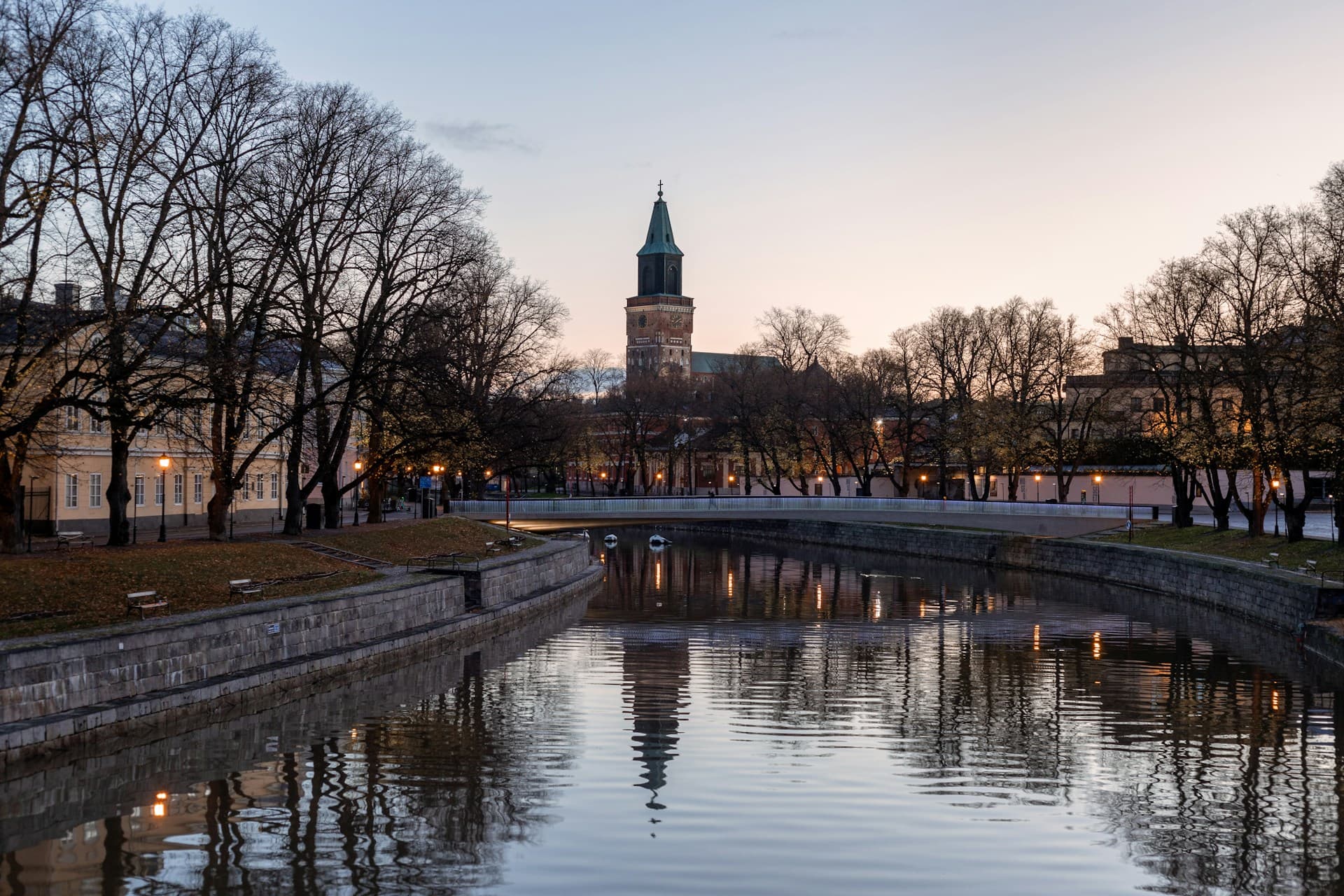
Turku
Turku
Turku, Finland's oldest city, brings together a medieval castle, a national cathedral, and an archipelago of thousands of islands. The former capital remains an essential cultural and university hub in southwestern Finland.
Turku is Finland's oldest city, founded in the 13th century at the mouth of the Aura River. A former capital of the country, it concentrates a medieval castle, a Lutheran cathedral, a rich cultural life, and an archipelago of thousands of islands within ferry reach. It is also the gateway to Stockholm across the Baltic Sea.
Practical information at a glance
- Access from Helsinki: approximately 2 hours by direct train (Intercity line) or 2 hours by bus.
- Airport: Turku Airport, just a few kilometers from the city center, with connections to Helsinki and European destinations.
- Local transport: urban bus network; bikes available for rent during the summer season.
- Recommended duration: 2 to 3 days to combine the city and archipelago.
- Languages: Finnish and Swedish (officially bilingual city); English is very widely spoken.
What to see
Turku Castle (Turun linna), built in the 13th century, dominates the mouth of the Aura River. The Lutheran cathedral, a Finnish national monument, stands at the heart of the old town. The Aura riverbank (Aurajoki) lines restaurants, floating bars, and museums. The Luostarinmäki district is home to an open-air craft museum, one of the rare collections of 18th-century wooden houses to survive the great fire of 1827.
History and context
Turku was the administrative and religious capital of Finland under Swedish rule for centuries. The great fire of 1827 destroyed most of the city; the capital was subsequently moved to Helsinki. Despite this, Turku has retained its role as a cultural and university center, with two major universities. In 2011, it was named European Capital of Culture.
Highlights of your visit
Turku Castle
Founded around 1280, the castle is one of the largest medieval buildings in Finland. Today it houses a history museum that traces the country's history from medieval times through the Renaissance. The vaulted chambers and dungeons are particularly well preserved.
Turku Cathedral
Consecrated in 1300, the cathedral is the Lutheran national monument of Finland. Its 101-meter tower is a visual landmark from throughout the city. The interior houses chapels dedicated to important Finnish and Swedish historical figures.
Luostarinmäki open-air museum
This 18th-century artisan district survived the 1827 fire intact. Workshops of cobblers, weavers, and printers are recreated here. It is one of the best-preserved open-air museums in Scandinavia.
The Turku archipelago
The archipelago comprises approximately 20,000 islands and islets. Regular ferries connect Turku to Naantali, Nagu, and inhabited islands. In summer, the archipelago route (Saaristotie) is passable by car with free ferry crossings.
The Aura riverbank
Along the Aura River, moored restaurant boats sit alongside lively terraces. This is the heart of Turku's social life, particularly vibrant in summer during the long Nordic evenings.
Photography tips
The soft light of the evening in summer (the sun sets late) is ideal for photographing the castle from the waterside. The cathedral photographs well from the market square (Kauppatori). For the archipelago, ferry crossings offer clear views of the forested islands.
Location and access
Turku is located in southwestern Finland, approximately 165 km west of Helsinki. The central railway station is just a few minutes' walk from the city center. Daily ferries connect Turku port to Stockholm (Sweden) and Mariehamn (Åland) via Viking Line and Tallink Silja. Accessibility for people with reduced mobility is good in the main museums and city center.
Nearby attractions
- Naantali — A small medieval coastal town about twenty kilometers away, known for its wooden old town and Moomin World park.
- Turku Archipelago — Thousands of islands accessible by ferry, ideal for hiking and kayaking in summer.
- Rauma — A UNESCO World Heritage site for its wooden old town, approximately 90 km to the north.
- Åland — An autonomous Swedish-speaking archipelago accessible by ferry from Turku port.
Frequently asked questions
Summer (June-August) is the busiest season: terraces are open, ferries to the archipelago are in full service, and there are long bright evenings. Winter offers a quieter atmosphere, sometimes with snow and renowned Christmas markets.
Two days are sufficient for the castle, cathedral, Luostarinmäki, and the Aura riverbank. Add an extra day if you wish to explore the archipelago or visit Naantali.
Yes. The train connects the two cities in approximately 2 hours. Turku fits easily into a Finnish itinerary by adding 2 to 3 nights to a Helsinki stay.
Regular ferries depart from Turku port to the archipelago islands. In summer, the archipelago route is passable by car with ferry crossings included on certain sections.
The castle houses a museum with paid admission. Exact rates should be verified directly with the museum, as they may vary by season.
Yes. The Luostarinmäki open-air museum, the castle, and proximity to Naantali with Moomin World park make it a family-friendly destination.
Want to discover this destination?
Our local advisors design your tailor-made trip.